Build in · Open source

Make documents inside your own .NET applications.

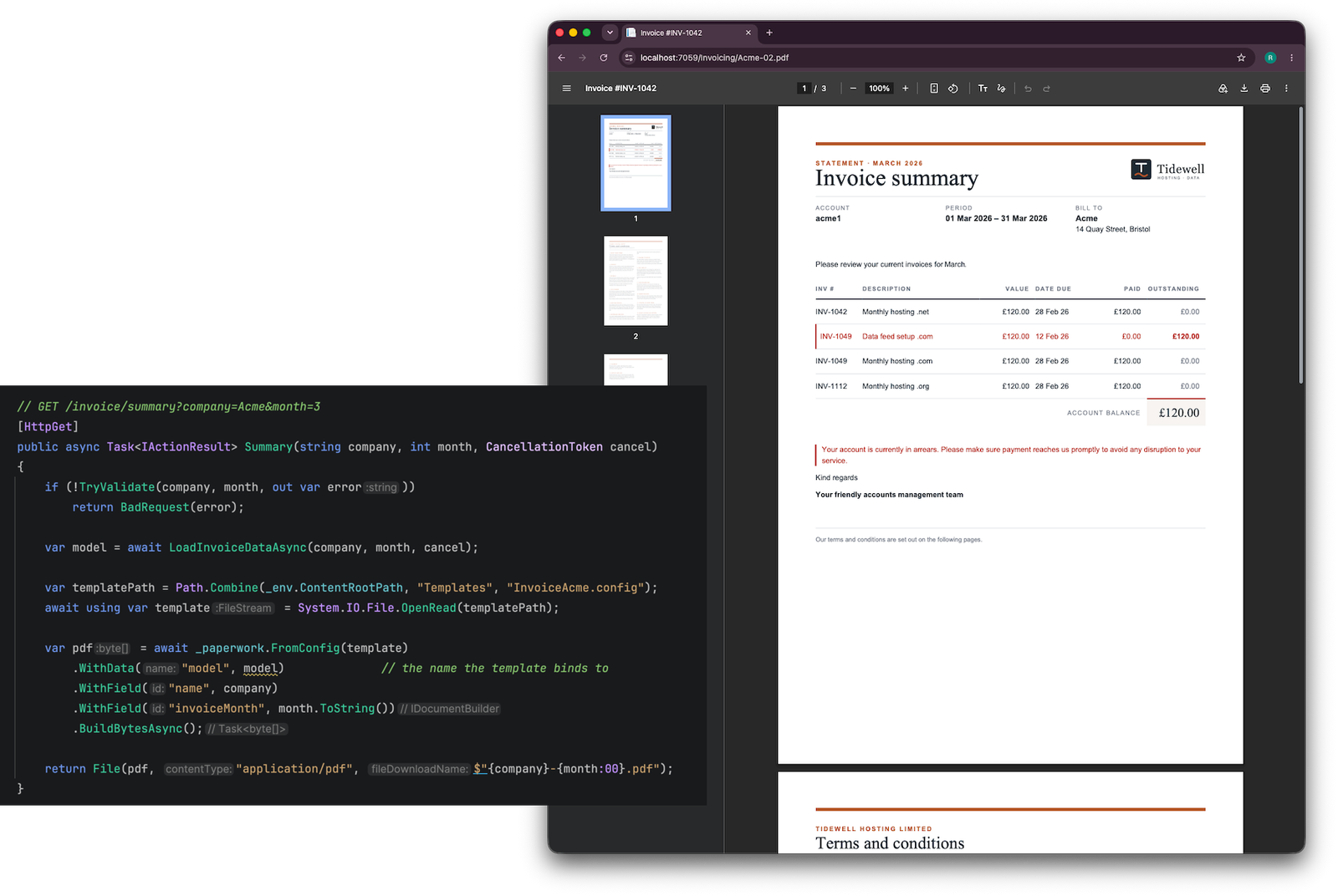
Paperwork.Core and Scryber.Core are the engine every Paperwork solution runs on. They're for developers who want PDFs from their own code, and they're open source.
Which one to use

Paperwork.Core

MIT licence

Use your Designer templates in your own code, published or exported, with a builder and dependency injection for .NET.

Scryber.Core

LGPL licence

Lay out your own HTML and CSS as a PDF, with no Paperwork templates.

Use it when

  • The document is made inside your own application or service.
  • You want the template released with your code, as a file you keep.
  • You want to read the code that makes your documents.

What you get

HTML and CSS in, PDF out.

Layouts, styles and your data, with expressions to fill in the details.

The same engine everywhere.

The Viewer, the CLI and the Designer all run on these libraries.

Open source.

Paperwork.Core is MIT licensed and Scryber.Core is LGPL. Both are on NuGet, and Scryber.Core's source is on GitHub.

Works with

How Paperwork works: start a template, shape it in the Designer, keep one template, then share and use it in the Viewer, your AI assistant, the command line or your own apps. 01 CREATE Start a template From something you have, or from nothing 02 DESIGN The Designer Where you create, update and publish your templates 03 KEEP One template Made once, then used for every document 04 USE Share and use it Make the PDF, filled in and ready to read Word documentBring in a .docx Other contentPaste in text you already have A blueprintStart from a ready-made template Blank pageStart from nothing From your AI assistantImport a design it drafted for you PAPERWORK.DESIGN On the pageClick, type and style In codeFull control of every part PreviewSee the real document with your data as you go Check inEvery change you check in is a saved version PublishOne approved version, for everyone who uses it StructureThe sections, pages and layout StylesThe same fonts, colours and spacing every time FieldsThe blanks people fill in DataFrom your own files, a web address you choose,or data your system passes in. PAPERWORK.VIEWEROnline viewerOpen it from a link, or on your website PAPERWORK.SKILLYour AI assistantAsk, and it fills in the fields for you PAPERWORK.CLICommand lineScheduled jobs, pipelines and automation PAPERWORK.COREYour own appsBuilt into software you make
How Paperwork works: start a template, shape it in the Designer, keep one template, then share and use it in the Viewer, your AI assistant, the command line or your own apps. 01 CREATE Start a template From something you have, or from nothing Word documentBring in a .docx Other contentPaste in text you already have A blueprintStart from a ready-made template Blank pageStart from nothing From your AI assistantImport a design it drafted for you 02 DESIGN The Designer Where you create, update and publish your templates PAPERWORK.DESIGN On the pageClick, type and style In codeFull control of every part PreviewSee the real document with your data as you go Check inEvery change you check in is a saved version PublishOne approved version, for everyone who uses it 03 KEEP One template Made once, then used for every document StructureThe sections, pages and layout StylesThe same fonts, colours and spacing every time FieldsThe blanks people fill in DataFrom your own files, a web address you choose,or data your system passes in. 04 USE Share and use it Make the PDF, filled in and ready to read PAPERWORK.VIEWEROnline viewerOpen it from a link, or on your website PAPERWORK.SKILLYour AI assistantAsk, and it fills in the fields for you PAPERWORK.CLICommand lineScheduled jobs, pipelines and automation PAPERWORK.COREYour own appsBuilt into software you make

Next Steps